The market reaction to the Citrini note was expected. The piece circulated across buyside desks immediately, and I flagged it to my team on Sunday as a volatility catalyst.
However, did it actually represent new information, or is the market—which doesn’t fundamentally understand agentic AI since most participants are not coders—looking for yet another (well-written) excuse to sell off?
Anecdotally, two weeks ago I presented to my team (fundamental equity L/S) what agentic coding is, and they were blown away. I got a glimpse that even very smart market participants haven’t grasped this (granted, it’s not a TMT-focused team, but still), and I expect more choppiness ahead. The consensus still largely views AI as a chatbot or a “glorified search engine” rather than an autonomous execution layer.
The consensus (until recently at least) largely viewed AI as a chatbot or a “glorified search engine” rather than an autonomous execution layer.
Market’s dual narrative
The market is currently hunting for a narrative to justify a rotation out of software. We are seeing a contradictory dual-narrative take hold:
-
The Deflationary Thesis: AI will revolutionise everything, destroying the moat of traditional SaaS (Sell Software).
-
The Bubble Thesis: The Capex spend is unsustainable and ROI is non-existent (Sell Semis/Hardware).
If you follow the logic of agentic AI to its terminal conclusion, we are looking at a restructuring of the knowledge economy and consumer economy after that.
Citrini’s post summarises this thesis:
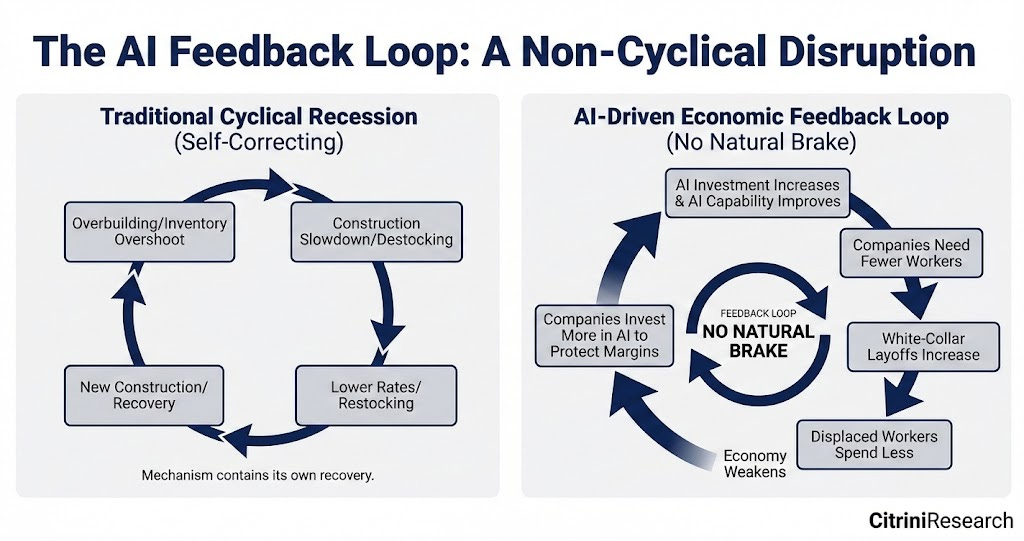
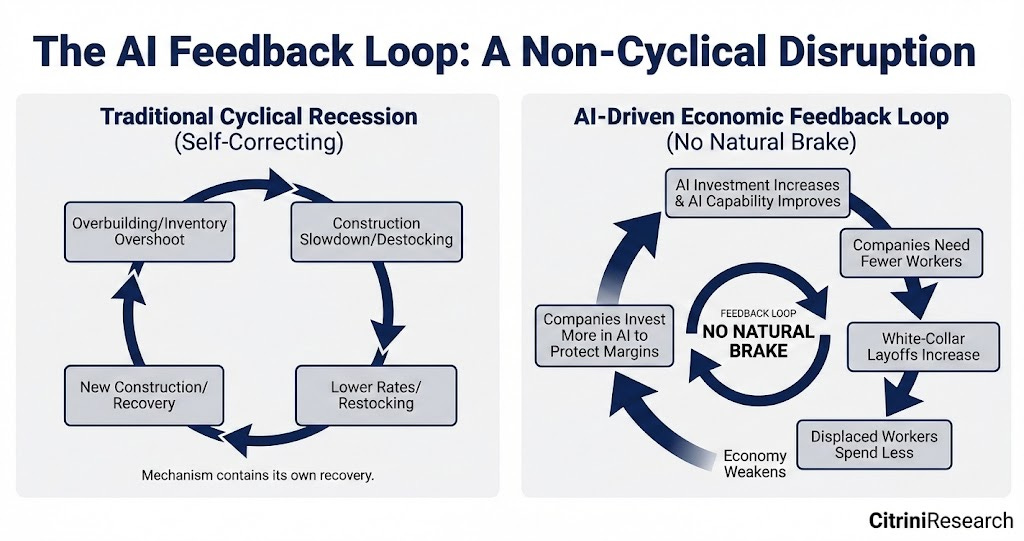
It’s not software engineers that will be replaced. Code is upstream from everything that happens on a computer. Since agents can code, all knowledge work will be impacted.
The Economic Terminal Point: Equilibrium or Collapse?
However, I feel the “replacement” narrative is too binary. My experience aligns with recent data suggesting AI acts as a force multiplier that intensifies work rather than merely reducing it (HBR Study).
That clearly means that we will need less people to do the same amount of work. The danger for white collar jobs is real and I won’t even go into robotics and blue collar that’s next.
Case in point: unit economics of junior labor. They are deteriorating fast. If the choice is between a fresh graduate and an agentic coder, capital allocation dictates the latter. We are already seeing this in UK’s new graduate positions data: UK Graduate Jobs Drop.
What puzzles me though is that I don’t see the doomsday scenario happening. Maybe I don’t want to accept it, maybe I’m too biased. Either all of us being unemployed and struggling to make ends meet or the utopian dream of just chilling and singing kumbaya because AI will do the job for us.
But if labor participation collapses, aggregate demand vanishes. Who buys the goods? Who pays the taxes? (AI’s terminal conclusion and doomsday scenario)
I know humans always adapt and reach an equilibrium. I know we overhype a new technology and create bubbles because of that. I also know we assume the rest of the system stays fixed because we can’t see that far ahead. I know there’s no incentive from anyone (esp governments) to have people doing nothing. A job is not just about money.
I don’t have a clear picture how the optimistic scenario will look like. What new jobs will show up and how existing ones will change and the velocity of that.
The obvious doom trade seems more and more overcrowded. I think (hope?) market is doing a classic error of assuming everything else stays static - “all else being equal”. It assumes demand is fixed and AI simply captures a larger share of the pie.
We aren’t just doing the same work with fewer people; we are likely expanding the total addressable market of solvable problems. The system will re-rate to a new equilibrium, as it always does. I found this X post from Kobeissi making the same argument (with nicer words and structure): https://x.com/KobeissiLetter/status/2026125293149163694